
Hillsboro City Directory Holdings
Brookwood Library is the verified starting shelf for historical Hillsboro directories. The WCCLS genealogy list identifies Hillsboro, Oregon, City Directory: a Classified Business Directory, a Rural Route Directory, published by Johnson Publishing Co. of Loveland, Colorado. It is reference material at Hillsboro Brookwood Library, with a displayed call number of REF 979.5 HILLSBORO 1975 and catalog coverage stated as 1959 to present. That catalog wording is an entry point, not proof that every annual issue survives locally. Ask staff for the exact year before making a special trip.
| Collection | Years | Where Held | Access |
|---|---|---|---|
| Johnson Publishing Hillsboro directory | 1959 to present in the catalog, issue holdings to confirm | Brookwood Library / WCCLS, REF 979.5 HILLSBORO | Reference collection; request the needed year |
| Hilhi annuals | 1916-1986, with gaps | Brookwood Library / WCCLS, REF 979.543 HILLSBORO | In-library school-year context |
| Hillsboro Argus and Independent | Argus 1894-March 2012; Independent 1891-1931 | Brookwood microfilm | Browse the cited issue or search a date range |
| Selected digitized Hillsboro papers | Title-specific runs from 1874-1922 | University of Oregon Historic Oregon Newspapers | Free keyword search and browsing |
| Hillsboro Obituary Index | Early 1890s-2018 | City of Hillsboro / Brookwood | Citation finding aid, not full obituary text |
The title confirms classified-business and rural-route material. An alphabetical name listing is part of the catalog description, but the contents of a particular volume must be checked in its front matter. A later street guide, reverse listing, or other companion section should never be assumed from a different year or edition.
See the WCCLS genealogy list for the Hillsboro directory record before asking for a year at the reference desk.
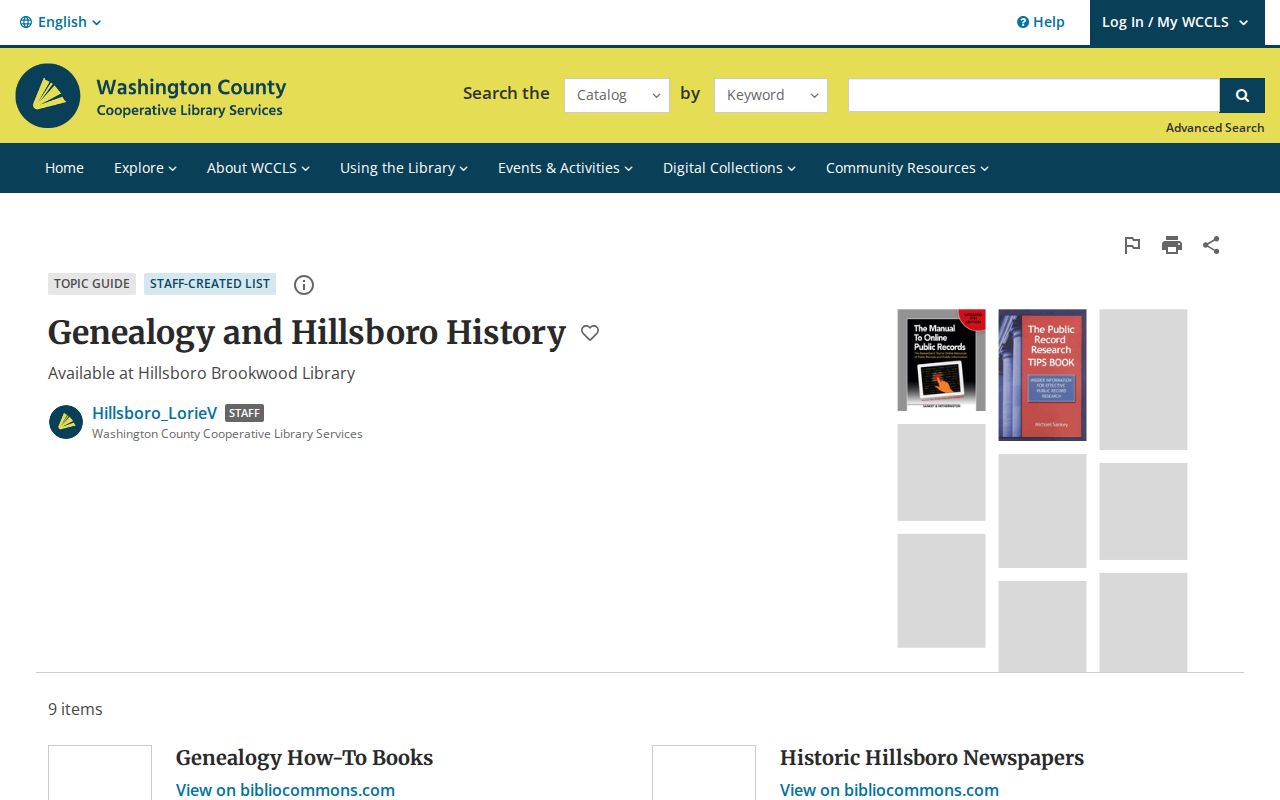
The catalog view establishes a shelf and call-number lead, while staff or the physical volume establishes whether the selected issue is available.
Brookwood's Hillsboro Reference Shelf
Brookwood is more than a catalog stop. Its genealogy collection includes books, newspapers, directories, and a second-floor microfilm reader. The library holds county court, marriage, estate, and other historical microfilm, plus Hillsboro Sanborn maps on microfiche for 1884-1921. Its FamilySearch Affiliate access can expose digitized material that is otherwise restricted, but it works only on library computers or public Wi-Fi. Image availability can still depend on the record and its access agreement.
The library can be reached at 2850 NE Brookwood Parkway, Hillsboro, OR 97124, or 503-615-6500. Bring a year, surname variants, and a possible address or route. That makes it easier to request a specific reference item instead of treating the desk as a general people search.
Brookwood's holdings are part of the wider Washington County Cooperative Library Services history and local-reference network.
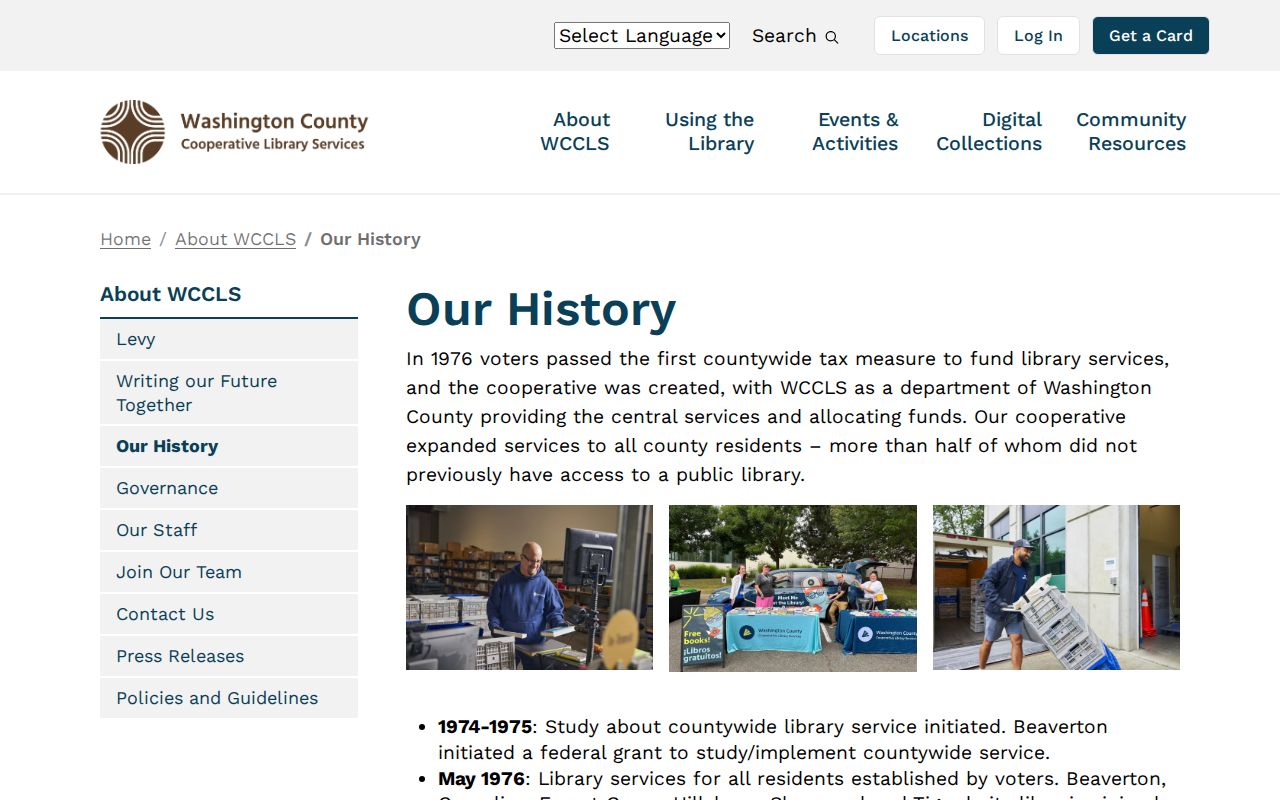
Use the local-history desk to identify the held volume, then keep the edition date with every transcription or scan note.
Hillsboro Directory Gaps in Print
When the directory trail goes quiet, newspapers supply dated context. Brookwood has Hillsboro Argus microfilm from 1894 through March 2012 and Hillsboro Independent from 1891 through 1931. Online material has a different shape. Historic Oregon Newspapers offers selected title runs: Washington Independent from October 30, 1874 to January 25, 1877; one 1881 Washington County Independent issue; The Independent from 1882 to 1890; Hillsboro Independent from 1893 to 1908; and The Hillsboro Argus from 1895 to 1922, with the additional short Argus run noted in the collection.
Search the digitized papers for a name, address, business, or event, then preserve the paper title, publication date, page, and column. For later years, turn to Brookwood's microfilm. The two channels overlap unevenly, which is why an empty online search cannot settle a historical question.
The University of Oregon Historic Oregon Newspapers collection provides the searchable early runs.
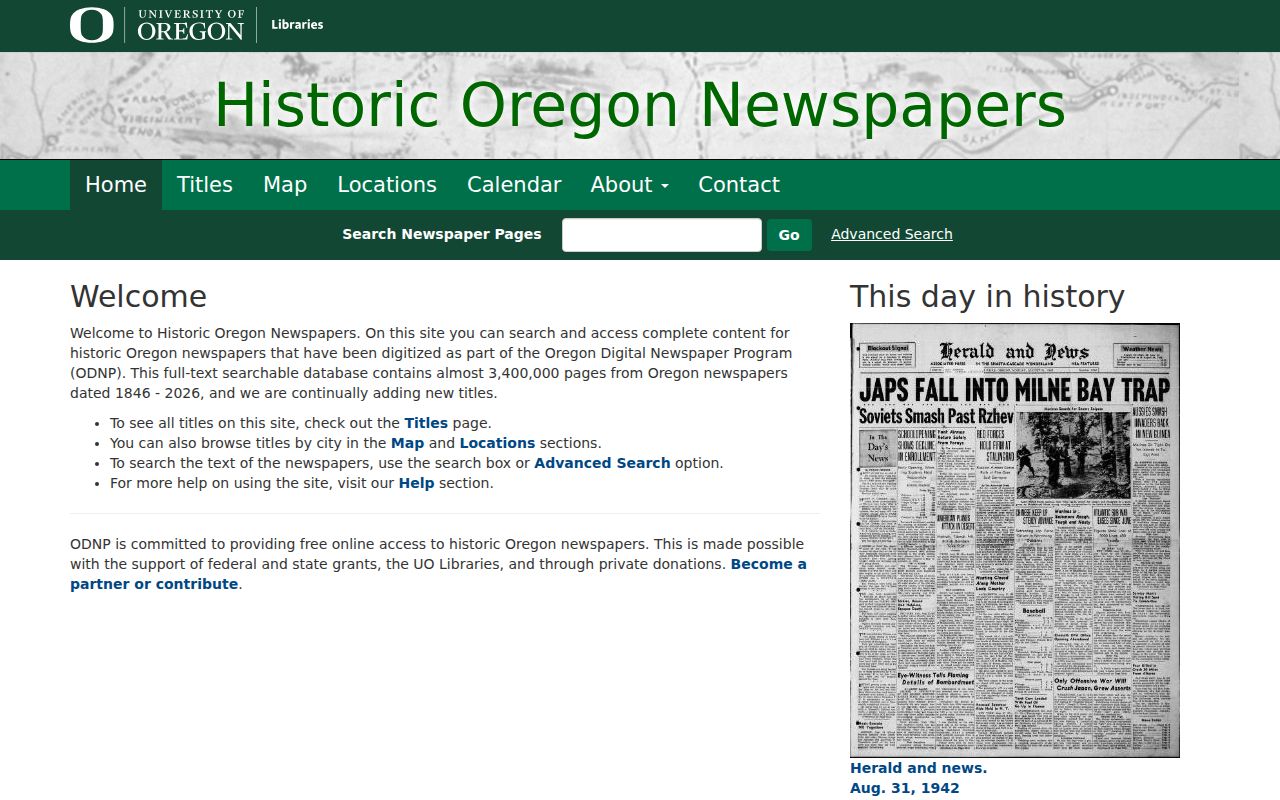
A newspaper item is dated context for a directory clue, not a replacement for the library's reference volume or the original cited paper.
Note: Digitized newspaper coverage ends at different dates for each title, so use the library microfilm when the needed year falls outside an online run.
Reading a Hillsboro City Directory
Read the front pages before interpreting a listing. The verified Johnson title includes classified-business and rural-route components, yet a public scan of a Hillsboro issue was not available to confirm its exact abbreviations, household marks, or individual fields. Copy only what the selected page actually prints. The alphabetical section can supply a spelling, business, or route. A street-oriented companion section, if it is present in that issue, can test the address. Rural-route wording may be the key when a later street number does not appear.
| Publication date | Record the year and edition before comparing it to any other source. |
|---|---|
| Name or business | Transcribe spelling, initials, suffixes, and business wording exactly. |
| Address or route | Keep the printed house number, street, or rural-route language without modernizing it. |
| Section heading | Note whether the clue came from alphabetical, classified, rural-route, or another verified section. |
| Notation | Use the edition's own abbreviation key; do not import symbols from another directory. |
- Abbreviation key
- The front-matter legend that defines shortened words and marks in that edition.
- Rural-route directory
- A title-confirmed section that can preserve route wording when a city street number is absent.
- Criss-cross directory
- A street-order or reverse-address listing found in some directory systems. Verify that it exists in the selected Hillsboro volume first.
After transcription, compare the printed address or route with a newspaper notice, Sanborn map, tax material, or census record from a compatible date. Keep the directory's edition and page with the note. A modern address conversion can be useful later, but it should not overwrite the historical wording that the source actually used.
Hillsboro Obituary Citation Trail
The City of Hillsboro Obituary Search is a helpful endpoint check for a person last seen in local print. It covers notices from the early 1890s through 2018 in the Independent, Argus, Hillsboro Argus, and Hillsboro Tribune. The form accepts partial last, first, middle, or maiden names, plus death or birth dates, spouse, survivor, and source text. Its result list can show a name and dates; a detail record may also contain a spouse, survivors, notes, and a source citation.
The source normally identifies the newspaper date, page, and column. Use that citation to view or request the original at Brookwood by visit, mail, or email. The City says the index is incomplete and does not contain full obituaries, so an absent result is not proof that a notice never appeared.
Start with the Hillsboro Obituary Search form when the approximate event date or spouse name is known.
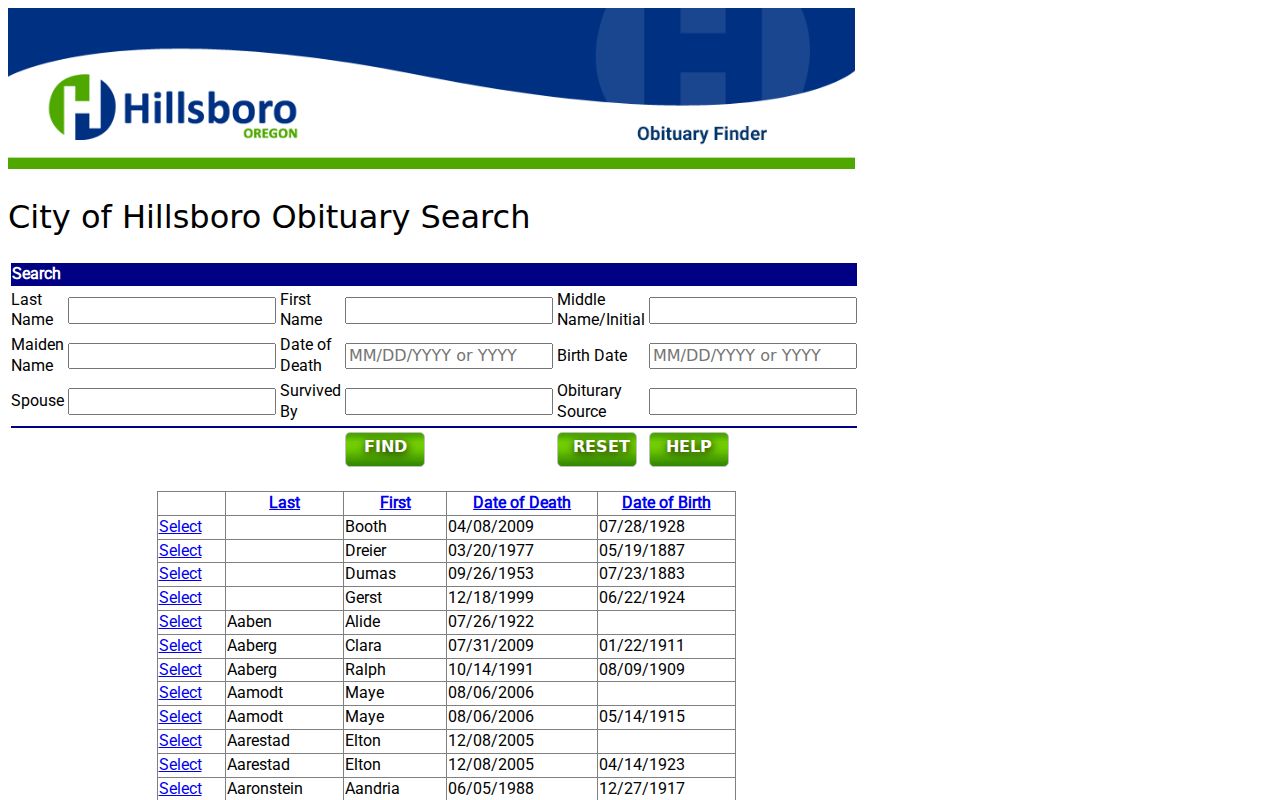
The result is a route back to the original newspaper, where the date, page, and column can be checked in context.
Hillsboro Annuals and Census Years
Hilhi annuals, catalogued for 1916-1986 with some missing years, offer school-year identity and community context that a directory cannot promise. Pair an annual with the nearest available directory and a newspaper search, rather than treating school inclusion as continuous residence. The most recent federal population census generally open for public research is 1950. For earlier periods, State Archives and county repositories list Tuality and Washington County census or abstract material for several nineteenth- and twentieth-century dates.
The names of the county also matter. Washington County began as Tuality District in 1843, and older catalogs or census descriptions may use Tuality instead. Try both county names where a catalog supports keyword searching. Hillsboro's 150th anniversary in 2026 is also a timely reason to use City archives, Brookwood, and the verified anniversary resources for institutional history rather than guessing from an undated online copy.
Note: An annual, census entry, newspaper notice, and directory each answer a dated question, so combine them instead of treating one as an uninterrupted timeline.
Hillsboro Directory Sources Beyond Brookwood
When the library shelf ends, choose a repository by date and record type. The Oregon Historical Records Index is the official name index for Washington County delayed births, estates, naturalizations, and historical divorces. It is a lead to original material or copy service, not the record itself. The Washington County Museum Research Library and Archives holds land-deed abstracts from roughly 1850-1940, census abstracts and films, historic assessment rolls, official elector registers, Sanborn and other maps, and a typed probate-index book.
Washington County Heritage Online, hosted by Pacific University Archives, contributes thousands of historic images, documents, and oral histories. Its Homes & Streets collection is useful for dated building and street context after an address appears in a directory. The State Archives inventory also identifies selected Washington County tax-roll and deed-index materials at the Oregon Historical Society. These repositories cover different slices of the record trail, so retain the holding institution and date with each lead.
Trace Families Through Hillsboro Directories
A household trail works best as a dated sequence. First choose the available Johnson directory closest to the event, then compare the preceding and following available volumes. Keep exact spelling, address or route, and every notation. If an address changes, preserve the old wording before checking maps or county property material. When the goal shifts to a modern address-keyed record, use the Hillsboro By Street directory; when the goal is to verify a named contemporary record, use the resident lookup route.
- Request the nearest dated directory and transcribe the entry exactly as printed.
- Check the next available earlier and later issues, without assuming annual continuity.
- Use the obituary citation and original newspaper to test whether a disappearance reflects death, a move, or a publication gap.
- Pair the relevant period with a 1950-or-earlier federal census where it fits, then consider tax, deed, or probate material by party name and legal description.
- For a rural route or older street, compare Sanborn, plat, or tax-map context and retain a source-and-date log.
For deeper records, the Oregon Historical Records Index can point to Washington County delayed births, estates, naturalizations, and historical divorces, while the Washington County Museum holds deed abstracts, census materials, maps, and probate-index resources. Pacific University Archives' Washington County Heritage Online adds dated Homes & Streets images and oral-history context. These sources add evidence around a household trail; none supplies a present-day roster.